
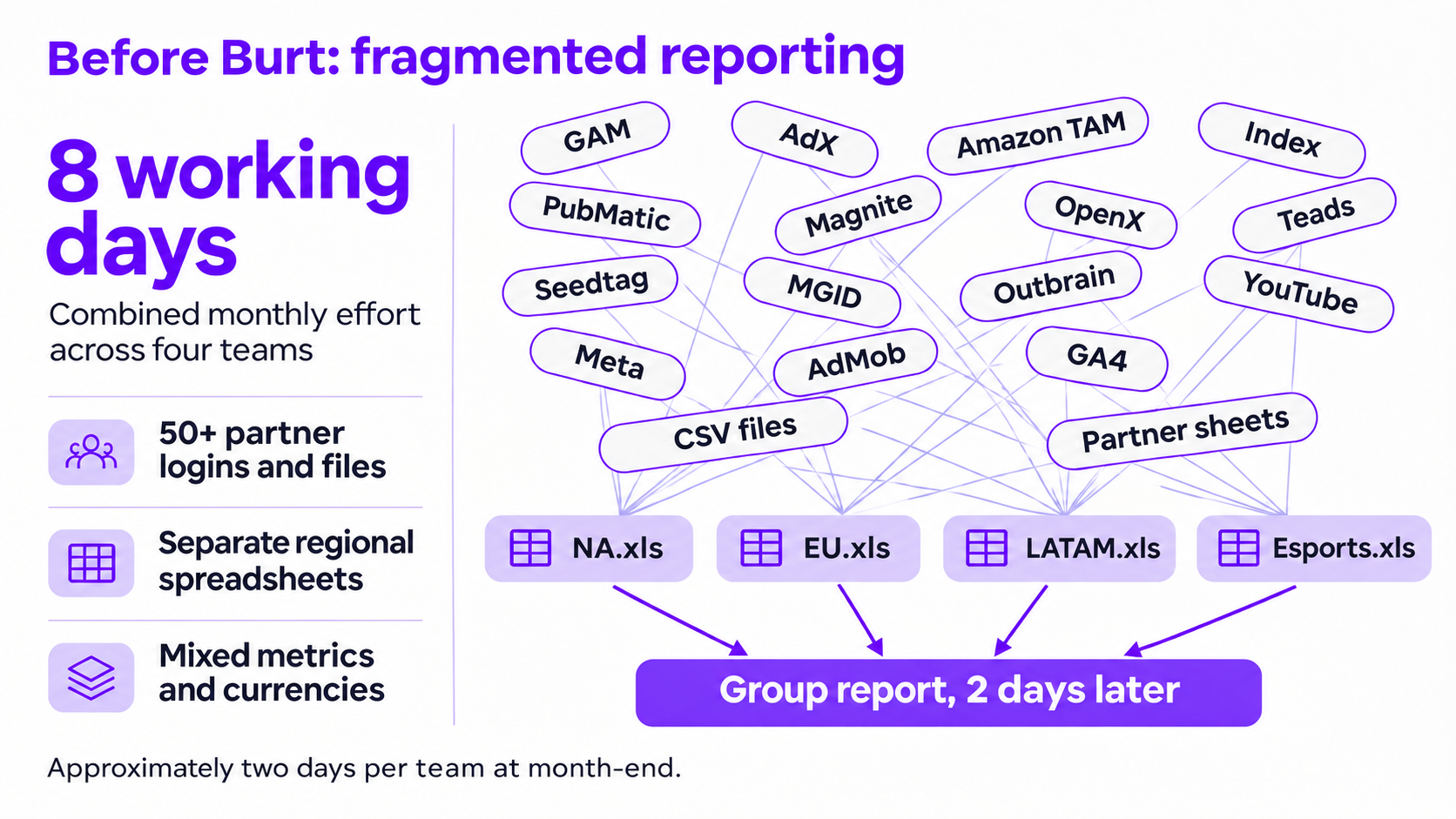
Better Collective’s month-end reporting used to start with dozens of partner logins, downloaded files and regional spreadsheets. Across North America, Europe, LATAM and esports, the work took roughly two full days per team.
With Burt, one person now prepares consolidated reporting for all four teams in about three hours. More than 50 revenue and audience data sources feed a unified dataset that supports finance reporting, daily analysis, management dashboards and questions through Claude.
From approximately eight combined working days across four teams to about three hours for one person.
Four teams repeating the same work
Better Collective operates a global portfolio of sports, esports and betting media, including Action Network, Yardbarker, HLTV and FUTBIN. At the time of the presentation, the group reported more than 450 million monthly visits.
Reporting spanned more than 30 SSPs alongside ad servers, YouTube, audience analytics and other sources. The same partner could have separate accounts for different regions, each with its own placements and reporting conventions. Teams had to collect the files, convert currencies and assemble the numbers before finance’s billing deadline.
Once that was done, the programmatic managers still needed to explain performance and decide what to do next. Two days spent preparing reports left less time and energy for that work. Monthly action planning could slip into the second week.
Revenue and audience data in one place
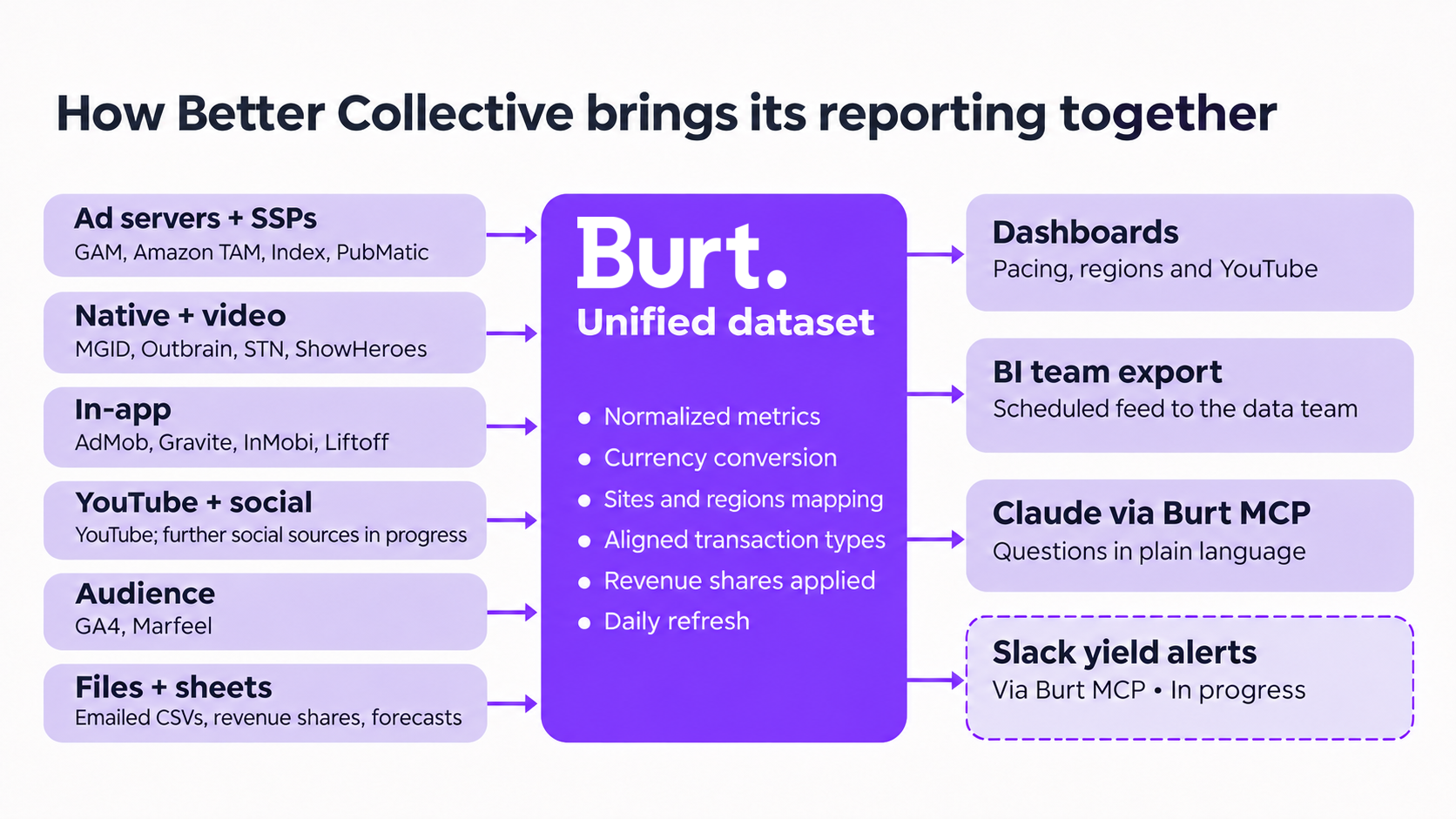
Burt brought those sources into a common reporting model. Metrics are normalized, currencies converted, sites and regions mapped, and revenue shares applied. The data refreshes daily, giving regional teams and group stakeholders a consistent basis for reporting.
That includes audience data from GA4 and Marfeel alongside advertising revenue. Teams can calculate metrics such as revenue per session and compare revenue and traffic with forecasts by site, without manually moving between analytics tools and partner dashboards.
For billing, Better Collective uses data pulled directly from SSPs because it more closely matches what those partners pay. Saved reports provide the figures finance needs, while scheduled exports supply the BI team’s Tableau reporting for management.
This is where Burt’s programmatic reporting changes the workload: the recurring collection and normalization happen centrally, so teams can spend their time investigating performance.
Three months to go-live
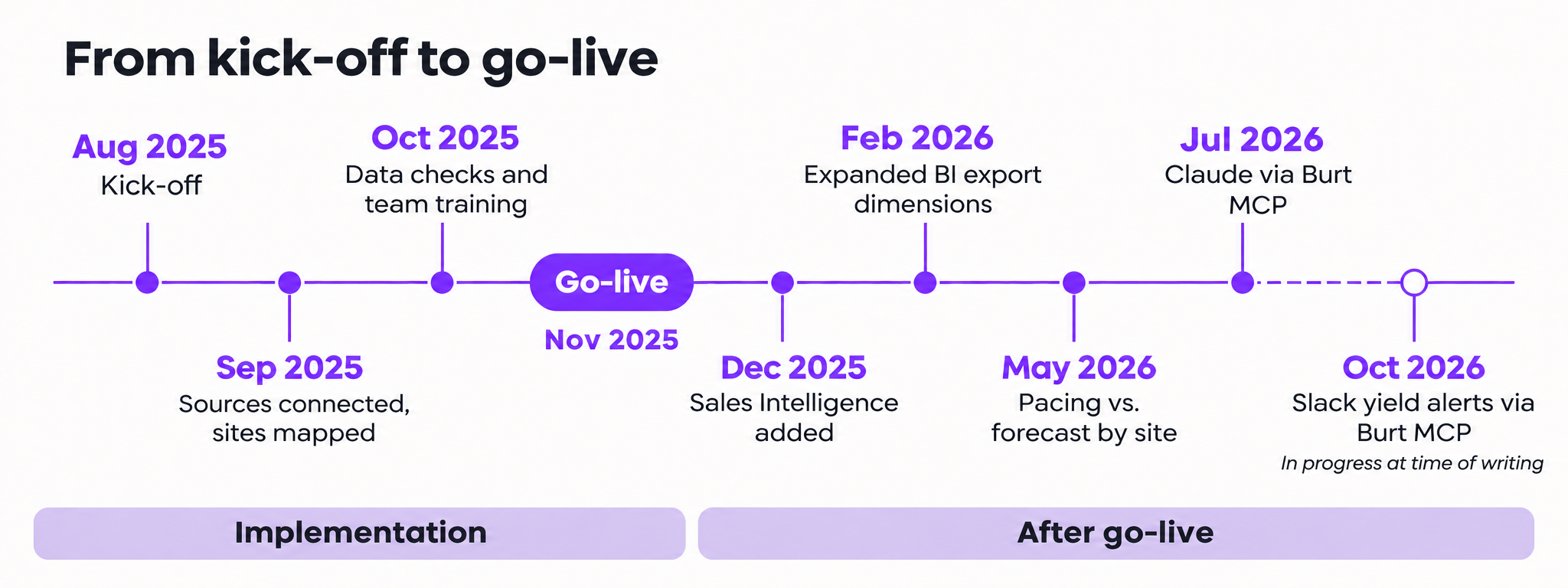
The project began in August 2025 and went live in November. Connecting sources was only part of the implementation. Burt and Better Collective also mapped placements to domains, aligned regional data and checked that revenue was counted once, even where multiple accounts overlapped.
Inconsistent placement names required cleanup. The project reinforced the value of shared naming conventions, including clear distinctions between display and video. It also prompted the team to reassess which demand partners justified the work of maintaining them.
The setup continued to evolve after launch, with Sales Intelligence, additional BI export dimensions and pacing against forecasts added over time. Slack yield alerts through Burt MCP remain in progress at the time of writing.
Asking questions through Claude
In July 2026, Better Collective added Claude access through Burt MCP. Team members can ask questions about the unified data in plain language or request a dashboard with the metrics they need.
One example was checking a partner’s revenue after changes to ads.txt. Instead of opening the partner’s interface and building another report, the team could ask Claude for the daily trend. A team member also described building a first dashboard in about seven minutes.
The foundation for that work was already in place: the connected, normalized data in Burt. Claude gives the team another way to explore it, alongside their existing dashboards and saved reports.
“Before using AI, it’s very important to have a unified data source and a single source of truth. That’s where Burt helps us.”
More time to act on the numbers
Month-end reporting now takes about three hours, with one person covering all four teams. That person has been able to take on more programmatic operations and analysis, while regional managers can begin their monthly action planning earlier.
“This has helped us understand that we’re not report aggregators. We can focus on insights.”
The benefit extends beyond month-end. Revenue and audience data are available together for routine performance checks, discussions with editorial teams and questions about individual partners. Better Collective has moved from repeatedly assembling the numbers to using them throughout the business.
Based on Better Collective and Burt’s presentation, “What Worked: A blueprint for unified reporting across the globe,” at Beeler.Tech Base.Camp Madrid.
Explore Burt Programmatic Reporting to see how your team can bring partner data, revenue and audience reporting together.