

Retail Media Network Reporting
Seamlessly connect to 200+ advertising and media data sources
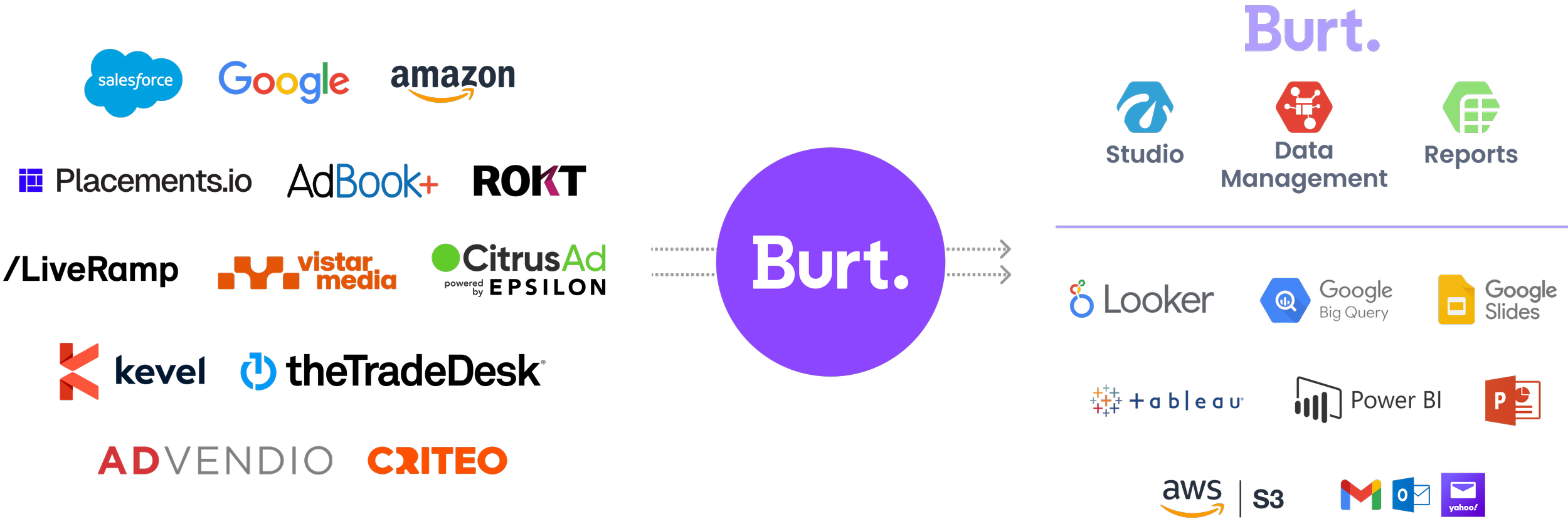

Burt provides enterprise analytics and reporting software built for retail media networks, delivering full visibility across campaigns, inventory, pricing, and revenue.
Connect to a centralized retail media analytics platform built on Burt’s broader publisher analytics software, supporting retail media and emerging commerce media networks with a unified data layer. Track revenue streams and performance metrics across endemic and non-endemic advertisers, spanning in-store, on-site, and off-site media.
Gain a centralized view of all incoming data by integrating your retail media technology stack into Burt.
Make faster, more informed decisions and adjust omnichannel advertising strategies as needed. Deliver automated, professional reporting for internal teams and client-facing reporting needs.
Maximize Ad Revenue With AI-Powered Forecasting
Burt’s ad inventory forecasting empowers Retail Media Networks to unlock the full potential of their ad inventory. With precise audience and inventory forecasts, you can confidently plan campaigns, prevent overbooking, and ensure on-time delivery.
Gain a complete view of your ad network’s performance with real-time monitoring, proactive risk alerts, and AI-driven insights that optimize sales and revenue.

Automate forecasting, streamline operations, and make data-driven decisions that drive growth — so you can sell smarter and maximize every opportunity.
Request Demo
Reach out today to hear about Burt’s Retail Media Network solution.
Frequently Asked Questions
-
Retail media network reporting consolidates campaign, revenue, and performance data across on-site, off-site, and in-store advertising channels, including formats such as in-app, web, audio, influencer, and digital out-of-home (DOOH), enabling retailers to measure performance and optimize media revenue.
-
Retail media networks unify campaign and revenue data by consolidating inputs from ad servers, DSPs, OMS, CRM, and commerce platforms into a centralized reporting layer, enabling consistent reporting and analysis across systems.
-
Retail media networks use purpose-built ad inventory forecasting to predict campaign delivery, manage advertising inventory availability, and optimize pricing decisions across media offerings. Because retail demand is highly seasonal, forecasting must account for events such as back-to-school, Black Friday, and other holiday shopping periods, requiring longer historical windows than standard ad server forecasting.
Learn more about ad inventory forecasting accuracy and reliability. -
Retail media networks measure performance by tracking campaign delivery, revenue, and advertiser outcomes across channels. By combining advertising and commerce data, they can evaluate return on ad spend (ROAS) and assess incrementality to understand the true impact of media investment on sales.
-
Retail media teams monitor performance by tracking KPIs, analyzing campaign data, and reviewing revenue trends across advertisers and channels. Automated alerts help teams quickly identify discrepancies and performance issues without manual reporting.
-
Retail media networks use client-facing reporting to automate the delivery of consistent, presentation-ready reports to advertisers at scale. By combining advertising and commerce data, these post-campaign analysis reports provide a unified view of campaign performance, revenue, and ROAS across channels, improving transparency and eliminating manual reporting workflows.
-
Commerce media extends retail media beyond retailer-owned properties to include broader advertising opportunities tied to commerce data, such as off-site media, marketplaces, and partner platforms. Retail media networks are a core part of commerce media, and both require unified analytics and reporting to measure performance, revenue, and ROAS across channels.